"Lust, Caution" (Se Jie): The Yellow Woman in Cheongsam
The article does not contain spoilers of the film's plot, only critical thoughts on the clothing characterization and its gendered entanglement.
I still remember the time my mom brought me to the cinema to watch this by then very popular film. It is popular thanks to its none miserly contribution to sex scenes. Nevertheless, as a 14-year-old eagerly exploring nonheterosexuality, the penis, and vagina eroticism was not much of a deal to me. However, I want to write to you today not about the greatness of the eroticism the film. But anger, yes, again, anger. I HATE CHEONGSAM. I hate that yellow woman in Cheongsam's highly male-dominated aesthetic rule and trite narrative.
"Cheongsam also known as the qipao and sometimes referred to as the mandarin gown, is a Chinese dress worn by women which takes inspiration from the ethnic clothing of the Manchu people. The cheongsam is most often seen as a longer, figure-fitting, one piece garment with a standing collar, an asymmetric, left-over-right opening and two side slits, and embellished with Chinese frog fasteners on the lapel and the collar" (Wikipedia). More to this, “The dress often uses flowery patterns, colourful collars and stylish buttons to represent the so-called beauty of Chinese women” as tenuous, fragile, and flexible" (Lee and Chung).
The movie spent a significant amount of depiction on this element as a form of showing not only gender and sexuality but also the relationship between the two protagonists, Wang and Yee. The figure-fittingness of the dress is a metaphor that unpacks the suffocating repressing relationality of Wang (the female protagonist) to Yee (the male protagonist). The cheongsams make Wang’s body exceptionally shapeable and moldable as if her body is captured and managed by Yee, just like how the dress contains and imprisons her body; her everythingness is regulated by Yee. Her body not only integrates with the dresses into somewhat a form of ornament that Yee persistently sexualizes, but also unravels a process of thingification.
First, Wang's femininity is reproduced and reinforced through cheongsam's inorganic and insensate medium. Her body is made of equipment in favor of patriarchy and is highly commodified. The cheongsam transfers into a sense of man-made gesture that captures Wang, in which Wang’s subjectivity is stressed as embellished; it is simultaneously displacement and removed by the garment. Wang’s body and subjecthood are locked and seized by such ornamental artifice, which manifests as decorative. Wang’s body thus lingers in between the sense of inorganicness and syntheticness. She is neither a human nor a nonhuman. She becomes an ornament dress in artificial cloth. The dress gives entitlement to the strategies that disseminate the femaleness, sexuality, and corporeality as a sense of style – a style that does or does not need the body; the female corporeality is dematerialized; Wang is made and remade to wear, to look at, to eat, to smell, to taste, and to play by Yee.
While the dresses highlight her body curves, they reveal a sense of hyper-malleability as if they are the shatters of her deprived subjecthood. Wang’s subjectivity is not only always already man-made but also signifies a put-together-ness, namely, a piece of patchwork that is reassembled by patriarchy. Her body can be made and remade by the inspection and control of Yee. The cheongsams are what give her a form. The dress is Yee’s patriarchal dream of Wang as inorganic and regulated property he owns. The yellow woman is a shapeless ghost; only when the form of cheongsam contains her she becomes visible and tangible. Wang’s flesh that passed through Yee’s gaze needs this cheongsam to return to itself; within this projection and inspection, she is managed and restrained in that costume and forever becoming an ornament of Yee.
In fact, these pieces of cheongsam do not need Wang; the yellow woman’s corporeal materiality disrupts Yee’s patriarchal composure. The movie gives multiple scenes to portray the violent sexual scenes between Wang and Yee by Yee violently throwing Wang to the bed and ripping off her cheongsam; not only the dress manifests as if it was Wang’s body, shattered into pieces, but also her subjectivity is granulated. The brokenness of the cheongsam is about a patriarchal fantasy of turning ornament/cloth into humans through the vehicle of female corporeality to imply further a sense of abandonment of her humanity and subjecthood. The relationship here, however, is not simply the dress manufactures Wang as an ornament, but a piece of a cloth/commodity/thing that does so by casting back the violence of Yee. In this way, Wang’s body can be seen as a fragmentized body that invites further ruminations about the interplay between fleshliness and the inorganic for her yellow femaleness.
The dress, I hate, simultaneously dematerializes Wang’s corporeality and subjectivity and materializes Yee’s making of a pure commodity and ornament that can be slipped open and sewed back together, used, and reused. Not only can the yellow female body leave her through commodification, but also that very commodity uncovers the “divergent, layered, and sometimes annihilating gestures” that can disguise themselves as East Asian female subjecthood (Cheng). Wang’s subjectivity is peculiarly synthetic, hovering between the human and nonhuman, centered on what I consider as the inorganic animation of converting the yellow female into a male-captured and owned ornament.
So yes, I HATE CHEONGSAM. I hate that yellow woman in Cheongsam and the male-dominated aesthetic canon.
References
Anne Anlin Cheng. (2019). Ornamentalism.
Astrida Neimanis. (2017). Bodies of Water: Posthuman Feminist Phenomenology
 Contributors to Wikimedia projects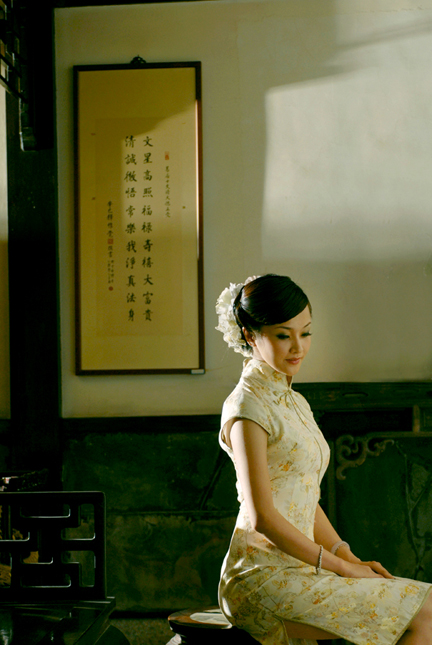
Chor Lin Lee and May Khuen Chung. (2012). In the Mood for Cheongsam: A Social History, 1920s-Present.